Bible Verse Suffered Under Pilate Was Crucified Rose Again on the Third Day
What Is the Nicene Creed? Its Significance in Church History

Find the origins of the Nicene Creed and what information technology means today for Christian churches around the earth. Learn more about its significance in Church history and why the Nicene Creed was created.
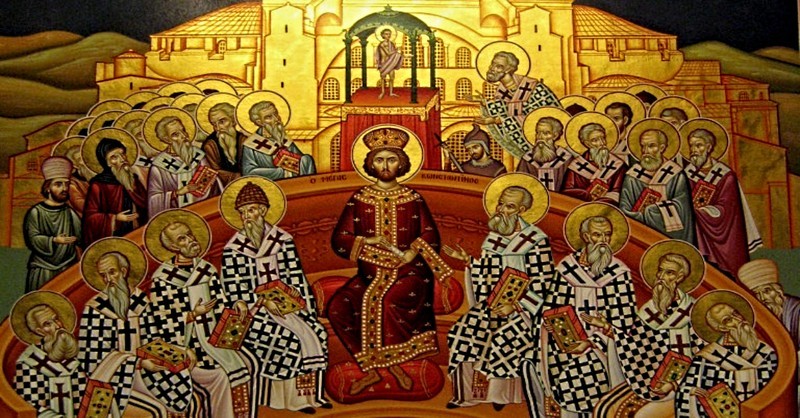
What is the Nicene Creed?
The Nicene Creed, also called the Niceno-Constantinopolitan Creed, is a Christian declaration of faith that is the sole ecumenical creed as it is affirmed as dogmatic by the Roman Catholic, Eastern Orthodox, Anglican, and some mainline Protestant churches.
The Nicene Creed was first recorded in Greek. Its primary liturgical use is in the connectedness of the Eucharist in the Western Church of Catholicism and in the context of both baptism and the Eucharist in the Eastern Orthodox Church building.
It is named "Nicene" because it was originally adopted in the metropolis of Nicaea (modernistic-24-hour interval İznik, Turkey) by the Start Council of Nicaea in 325. It was then revised at the First Council of Constantinople in 381, and the updated form is indicated as the Nicene or the Niceno-Constantinopolitan Creed.
Photo credit: Wikipedia/Jjensen
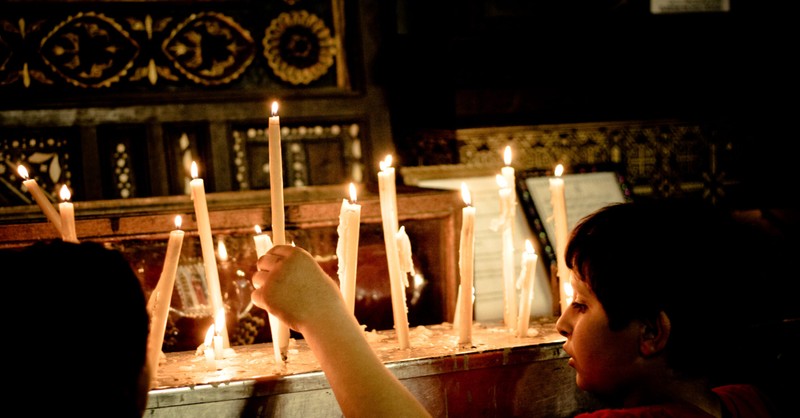
What does the Nicene Creed say?
A modern English version of the Nicene Creed is as follows:
I believe in 1 God, the Father almighty, maker of heaven and earth, of all things visible and invisible.
I believe in ane Lord Jesus Christ, the Only Begotten Son of God, built-in of the Begetter before all ages.
God from God, Light from Light, true God from true God, begotten, not made, consubstantial with the Father; through Him all things were made.
For us men and for our salvation he came down from sky, and by the Holy Spirit was incarnate of the Virgin Mary, and became man.
For our sake he was crucified nether Pontius Pilate, he suffered expiry and was cached, and rose again on the tertiary day in accordance with the Scriptures.
He ascended into heaven and is seated at the right hand of the Male parent.
He will come up again in glory to guess the living and the dead and his kingdom volition have no stop.
I believe in the Holy Spirit, the Lord, the giver of life, who gain from the Father, who with the Father and the Son is adored and glorified, who has spoken through the prophets.
I believe in one, holy, cosmic and apostolic Church.
I confess i Baptism for the forgiveness of sins and I await frontwards to the resurrection of the expressionless and the life of the world to come. Amen.
Image source: Public Domain
Who created the Nicene Creed?
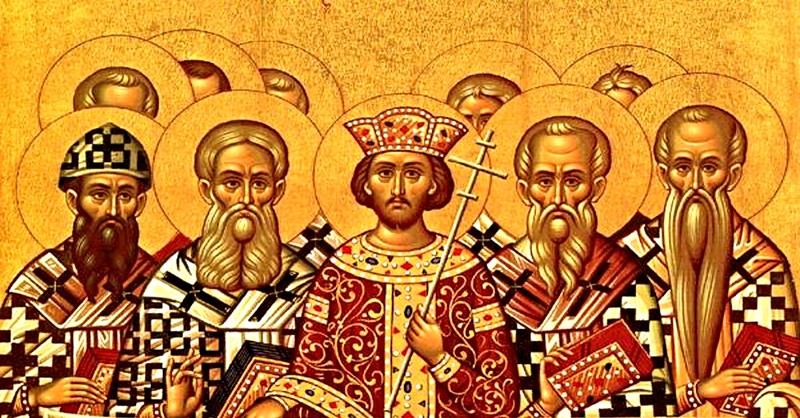
The Nicene Creed was established at the Showtime Council of Nicaea. This was a council of Christian bishops convened in the Byzantine metropolis of Nicaea past the Roman Emperor Constantine I in Ad 325.
This ecumenical council was the starting time try to reach agreement in the church through a coming together embodying all Christendom. Hosius of Corduba may have led over its discussions.
The main accomplishments of the First Council of Nicea were as follows:
- Understanding of the Christological outcome of the divine nature of God the Son and his human relationship to God the Male parent,
- The evolution of the first part of the Nicene Creed,
- Establishing a mutual observance of the date of Easter, and
- Promotion of early canon law.
Photo is a public domain image depicting Emperor Constantine and the bishops of the Offset Council of Nicaea (325) belongings the Niceno–Constantinopolitan Creed of 381
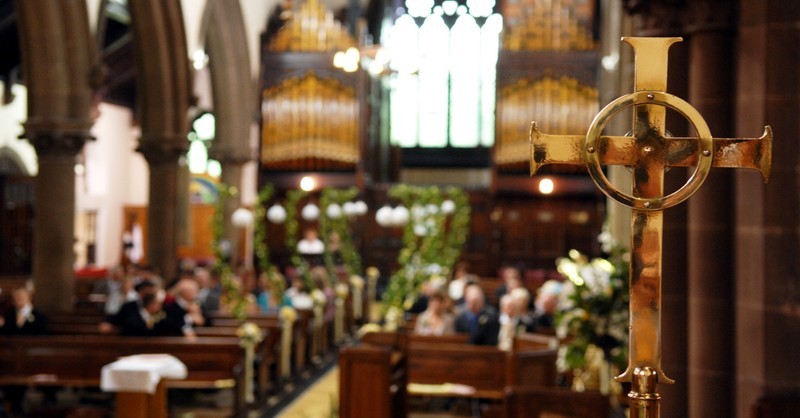
Importance of the Nicene Creed
The Nicene Creed was established to settle the Arian contention, whose leader, Arius, a chaplain of Alexandria, "objected to Alexander's (the bishop of the time) apparent carelessness in blurring the stardom of nature between the Male parent and the Son by his accent on eternal generation".
Alexander and his advocates formed the Nicene Creed to illuminate the essential beliefs of the Christian faith in response to the broad adoption of Arius' teaching, which was henceforth regarded as heresy.
The Nicene Creed of 325 clearly declares the co-essential divinity of the Son, connecting to Jesus Christ the term "agnate". The 381 version addresses the Holy Spirit as worshipped and glorified with the Father and the Son.
Use of the Nicene Creed Today
The Nicene Creed can serve as a standard of the true Christian faith, indicated in the name "symbol of faith", which was given to it in Greek and Latin when in those languages the word "symbol" designated a "token for identification".
According to Wikipedia,
"In the Roman Rite Mass, the Latin text of the Niceno-Constantinopolitan Creed, with "Deum de Deo" (God from God) and "Filioque" (and from the Son), phrases absent-minded in the original text, was previously the but course used for the "profession of faith". The Roman Missal now refers to it jointly with the Apostles' Creed as "the Symbol or Profession of Religion or Creed", describing the second equally "the baptismal Symbol of the Roman Church, known every bit the Apostles' Creed"."
The liturgies (church services) of the ancient Churches of Eastern Christianity which include the Eastern Orthodox Church building, Oriental Orthodoxy, Church building of the Eastward, and the Eastern Catholic Churches, utilize the Niceno-Constantinopolitan Creed, and never the Western Apostles' Creed.
In the Byzantine Rite, the Nicene Creed is chanted at the Divine Liturgy, straight preceding the Anaphora (Eucharistic Prayer), and is also recited daily at compline.
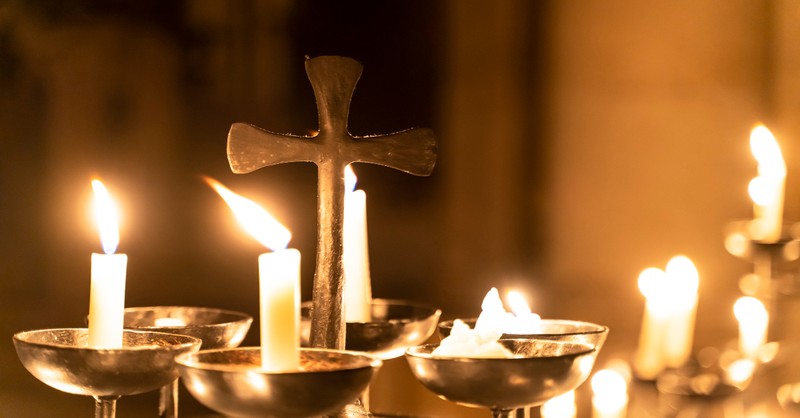
Photo credit: GettyImages/BulentBARIS; Top photo credit: GettyImages/Darkdiamond67

Source: https://www.christianity.com/wiki/history/nicene-creed-in-church-history.html
0 Response to "Bible Verse Suffered Under Pilate Was Crucified Rose Again on the Third Day"
Post a Comment